
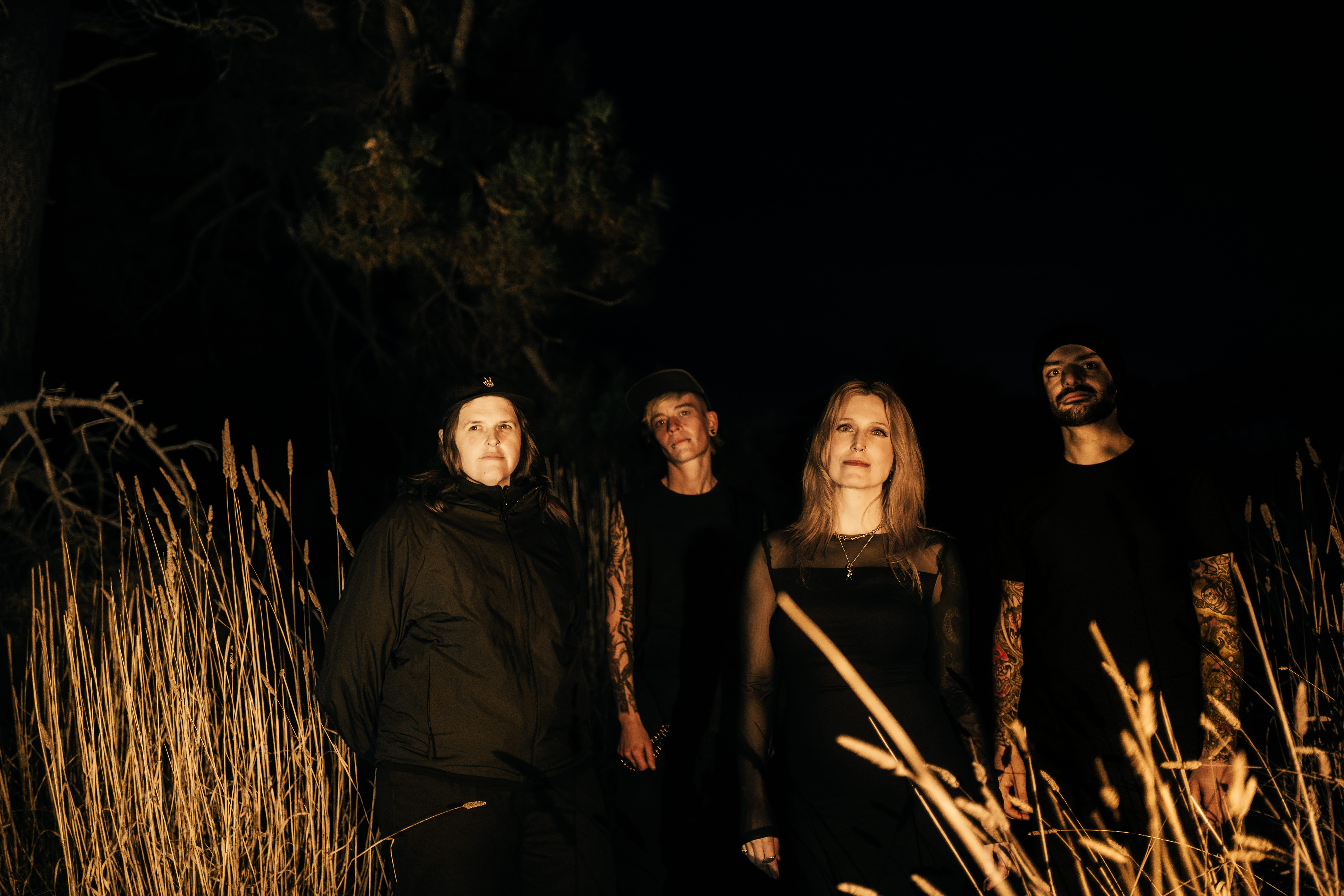
It’s easy to look around and think everything is disgusting. Turning that disgust into eleven songs that actually do something with it is another matter. That’s what Disgust, the new album from Stabbitha and the Knifey Wifeys, does. The Kaurna Land quartet (Adelaide, South Australia) take all that frustration and turn it into something political, physical and emotional at the same time. This is disgust aimed at what pisses you off, what wears you down and what tries to keep you in line.
Musically, the album starts from a very Motörhead-shaped place, with bass and guitar locked into a thick wall of distortion, drums that never let up, and that mix of metal, punk and rock ’n’ roll played flat out. You can hear echoes of The Distillers in the ragged vocals, the short songs and the melodies buried beneath all that ferocity. The singer pushes every line to the edge, with a rough, overflowing delivery that becomes one of the record’s biggest strengths. But Disgust regularly pushes into much heavier territory, somewhere between metallic hardcore and metalcore, with syncopated riffs, mid-tempo sections, groove and breakdowns that care more about impact than showing off.
When the band speed up, they tear through everything. When they slow down, the riffs get oppressive, almost industrial. There are flashes of classic heavy metal, melodic crust, Scandinavian death metal, sludge and post-metal along the way. None of it feels like a sudden change of direction or an attempt to prove how many styles they can play. It’s just different ways of hitting with the same force.
The lyrics are where the record really digs in. Mortality is everywhere, but not as some gothic idea hanging in the background. It’s physical. Bodies decay, memories fade, money burns, and in the end the earth takes everything back. The band call that inevitable decline beautiful despair, which pretty much nails it. It comes from knowing we’re here and knowing that, at some point, we won’t be.
Death isn’t the only thing in the firing line. Disgust also goes after labour exploitation, authoritarianism, religious violence, control over bodies and power structures dressed up as love, protection or salvation. Christian imagery keeps coming back, twisted into something ugly and uncomfortable: sacrilegious communion, dirty baptismal water, spat-out wine, flesh anointed or preserved in salt. It doesn’t feel like an attack on faith itself so much as the mechanism behind it. First they give you the guilt, then they sell you obedience as the cure.

That push and pull between oppression and resistance runs right through the album. A lot of these songs don’t just sit with the damage; they stop at the point where the person on the receiving end says enough. Lines about refusing to stay silent, reclaiming what belongs to a community and not letting anyone hold that kind of power turn anger from something private into something shared. The extreme vocals aren’t just there to sound aggressive either. They become another way of taking back space, body and voice.
Disgust is solid, compact and sounds huge. The riffs hit hard, the vocals stay right on the edge, and the band know exactly when to floor it and when to let a mid-tempo section land with full weight. Everything is clear without losing any of the rawness. This is not a record for sitting still. It makes you want to bang your head, grit your teeth and end up in the middle of a mosh pit.
Tour Starts September:
Brisbane – 5 September 2026
Adelaide – 3 October 2026
Newcastle – 4 December 2026
Lismore – 5 December 2026
Listen to Disgust on Bandcamp
Catch Stabbitha and the Knifey Wifeys on Instagram | Website | YouTube